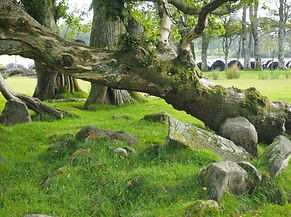
The Stone Circle at Lochbuie
The monuments comprise a stone circle and two other standing stones, all of prehistoric date and visible as a series of upstanding stones. The stone circle and one of the standing stones were first scheduled in 1964, but an inadequate area was included to protect all of the archaeological remains: the present re-scheduling rectifies this. The stone circle is situated on level pasture at the head of Loch Buie at approximately 10m OD. The two other standing stones lie some 40m SW of and 115m WSW of the stone circle respectively, but within the same present parcel of land. The stone circle originally consisted of nine stones. One of these is now missing and its position has been marked in recent times by a small boulder. The circle measures approximately 12.3m in diameter and is composed for the most part of granite slabs, which have been positioned with their flatter faces set towards the inside of the circle. The tallest stone stands about 2m high and measures c.0.85m by 0.3m at its base. An outlying standing stone, situated 4.6m SE of the circle, comprises a pointed granite block standing 0.85m high and measuring c.0.6m by 0.3m at its base. The single standing stone situated about 40m SW of the stone circle stands about 3m high and measures c.0.85m by 0.3m at its base, tapering to a fairly narrow top. The standing stone situated about 115m WSW of the stone circle comprises a comparatively flat-sided monolith, aligned NE and SW. This stands about 2.15m high, although the top has been broken off in antiquity, and measures c.0.75m by 0.7m at its base. Stone settings of this type are characteristic of the Neolithic period and normally date to the third millennium BC. Three separate areas are proposed for scheduling, as marked in red on the accompanying map. These include the remains described and an area around them within which related material may be expected to survive. The three areas are as follows:
1. The largest area is sub-circular in shape, centred on the stone circle and the outlying standing stone closest to the stone circle, and has maximum dimensions of 38m NW-SE by 33m transversely. Its NW limit is defined by, but excludes, the field boundary.
2. The second area is centred on the standing stone situated about 40 SW of the stone circle and is circular in shape, measuring 10m in diameter.
3. The third area is centred on the standing stone situated about 115m WSW of the stone circle and comprises a truncated circle, with a maximum diameter of 10m. It is defined to the NW by the field boundary, which is itself excluded from the scheduling.


Kerb-Cairn
at LochBuie
In a group of trees 380 m north north west of Lochbuie there are the remains of a kerb-cairn measuring about 6.5 m in diameter and 0.6 m in height and is still comparatively well preserved on the north and south sides. An unusual feature is the presence, on the southeast side, of two stones set at right angles to the line of the kerb, 0.9 m apart, forming a ‘false portal’ arrangement. The largest kerb-stone, immediately north of the ‘portal’, is 0.7 m high. Grid Reference NM 615 252 A slightly older and smaller site was confirmed close by to the north of the Lochbuie Standing Stone Circle c3500BC behind the castle. The Lochbuie Kerb Cairn was created about the time the first humans inhabited the island. The cist in the centre seems to mark the change from ritual cremation to ritual burial use around the middle 6th century which coincides with the arrival of St Columba at Iona in May 563 and Páidín's commission to Mull introducing Christianity and ritual burial as the site has numerous burial cairns for the inhabitants of Lochbuie for a millennium. The “false portal” is a direct indication of Christian influence as an entrance to the cemetery and the location of the Kerbs states hierarchy. Páidín (540AD-620AD) and his wife Bruidhe (570AD-640AD) are believed to have the largest Kerbs at the center with their children, spouses, and descendants have the others surrounding them. All the clerics are also buried within the Kerb-Cairn except Sir James Pethein, the last cleric who is buried at the chapel. Ground penetration shows numerous burials surrounding the Kerb-Cairn are believed to be generations of clan burials from 563AD - 1400AD.